The Explorer's Atlasof Business Frameworks
39 frameworks, and exactly when to use each one. Every page starts with a real “What if…?” from the Egyptian and Gulf markets, then shows you how to work through it.
Horizon Cliffs 6 FRAMEWORKS 1 Customer Oasis 6 FRAMEWORKS 2 Builders' Bay 4 FRAMEWORKS 3 Strategy Summit 5 FRAMEWORKS 4 Market Harbour 4 FRAMEWORKS 5 Engine Rooms 6 FRAMEWORKS 6 Compass Point 4 FRAMEWORKS 7 Your decision N Sales Caravan 4 FRAMEWORKS 8 Tap an island to jump to its zone, or follow the dotted route from Horizon Cliffs to your decision.
How to use this atlas
A framework is a lens, not an answer. The skill is knowing which lens to pick up for the situation in front of you.
This atlas is organised as a journey across seven zones. Each zone answers one business question, in the order you usually meet them: first read the market, then understand customers, design the business, choose a strategy, go to market, execute, and finally lead change.
You can read it front to back, or start from your problem. The situation finder lists more than 100 “What if…?” moments and points each one to the right framework. The expedition routes chain frameworks together for bigger journeys, such as launching a product or entering Saudi Arabia.
The seven zones
Horizon Cliffs What is happening around us? Customer Oasis Who are we serving, and what do they really need? Builders' Bay How will we create, deliver and capture value? Strategy Summit Where do we play, and how do we win? Market Harbour How do we take the offer to market and grow? Engine Rooms Are we executing well, and what is breaking? Compass Point How do we lead change and decide under uncertainty?
Every framework page shows
Reach for it when The situations that call for this framework.
Leave it in the bag when When another tool will serve you better.
What if…? A realistic scenario, worked through step by step.
How to apply The steps, in order, to run it yourself.
Traps on the trail The mistakes that make it useless.
Travels well with Frameworks to use before or after it.
Company names in the scenarios are illustrative, and figures are examples to show the method, not market data.
Situation finder
Describe what's happening, or pick a type of situation. Each “What if…?” leads to the framework built for it.
Search situations All situations Starting & launching Growth & expansion Competition & pricing Customers & sales Operations & problems Team & change Money & investment
Zone 1 of 8
Horizon Cliffs
What is happening around us?
Horizon Cliffs , landmark 1 of 6
PESTEL Analysis
Scan the big outside forces that no company controls: political, economic, social, technological, environmental and legal.
Your business P Political E Economic S Social T Tech E Environment L Legal Typical effort: 60–90 minute workshop
Reach for it when You are entering a new market or country You are writing a business plan or feasibility study A policy, currency or technology shift is hitting your sector Leave it in the bag when You want to know why one customer segment is leaving. That is a customer problem, not a macro one.
?
What if the pound drops 20% three months before your skincare launch?
Nile Glow, a new body-care brand, imports 60% of its scrub ingredients. A devaluation is expected, a new labelling rule has just been issued, and social commerce is growing fast in Egypt.
How to apply List what is changing in each of the six areas, as facts not opinions Rate each factor for impact and likelihood from 1 to 5 Keep only the factors that score high on both Turn each one into an opportunity or a threat Give every factor one action and one owner
Traps on the trail Listing everything and deciding nothing Using last year's numbers in a fast-moving economy Also reach for it when… What if the government changes import rules for your category? What if you are deciding whether to launch in Cairo or Riyadh first? Travels well with
Horizon Cliffs , landmark 2 of 6
Porter's Five Forces
Judge how attractive and profitable an industry really is by looking at the five pressures on its profits.
Rivalry New entrants Substitutes Supplier power Buyer power Typical effort: 1–2 hours with data
Reach for it when You are deciding whether to enter an industry Margins are shrinking and you don't know why You are negotiating with large suppliers or buyers Leave it in the bag when You are comparing two specific competitors' products. Use a perceptual map instead.
?
What if a Turkish brand enters pharmacies 30% cheaper than you?
A pharmacy-grade deodorant brand sells through 1,200 Egyptian pharmacies. A Turkish importer arrives with a lookalike at a 30% lower price, and the big chains are asking for extra margin.
How to apply Define the industry boundary clearly Score each force low, medium or high, with evidence Find the strongest force: it sets your profit ceiling Choose moves that weaken that force for you Check again every year
Traps on the trail Analysing the whole ‘beauty industry' instead of your real arena Doing it once and filing it away Also reach for it when… What if distributors demand a 35% margin to list you? What if you are choosing between two industries to invest in? Travels well with
Horizon Cliffs , landmark 3 of 6
Industry Lifecycle
Locate where the market stands today, from introduction to reinvention, so your strategy fits the stage.
1 Intro 2 Growth 3 Maturity 4 Saturation 5 Decline 6 Reinvent Time Market sales Typical effort: 45 minutes with sales history
Reach for it when You are planning how much to invest in a product line You must decide whether to educate, scale, defend or reinvent Investors ask ‘why now?' Leave it in the bag when You need exact sales forecasts. The stages give direction, not numbers.
?
What if everyone already sells scrubs – is it too late to launch one?
Body scrubs fill Egyptian pharmacy shelves, but products made specifically to detox the underarm are new. A founder wonders whether the market is too crowded.
Field plate: the six stages of an industry's journey in the Egyptian market.
How to apply Collect three to five years of sales, player count and price trends Match the signals to a stage Check sub-categories separately: they often sit at different stages Pick the matching play: educate, scale, differentiate, harvest or reinvent Set a signal that will tell you the stage has changed
Traps on the trail Treating a mature category as dead Assuming your niche shares the category's stage Also reach for it when… What if sales flatten after three strong years? What if you must decide whether to keep funding an old product line? Travels well with
Horizon Cliffs , landmark 4 of 6
Business Ecosystem Map
Map every player you depend on to launch and run the business: makers, suppliers, regulators, channels, influencers and customers.
Customer Makers Suppliers Regulator Distributor Logistics Retail Influencers Reviews Typical effort: 1 hour, sticky notes welcome
Reach for it when You are launching a new product or business You need to decide which partners to secure first You are briefing a team or investor on how the business works Leave it in the bag when You are choosing between strategies. The map shows players, not choices.
?
What if the formula is ready but you don't know who you need to launch it?
The Underarm Detox Scrub works in the lab. Getting it onto Egyptian shelves takes a whole chain of partners, and the founder has contacts with only two of them.
Field plate: every player you need to launch the Underarm Detox Scrub in Egypt.
How to apply Put the customer at the centre List every player that touches supply, approval, sales and influence Draw how product, money and information flow between them Mark each player as critical, important or nice to have Name the gaps and give each one an owner
Traps on the trail Forgetting regulators and influencers Drawing the map once and never updating it Also reach for it when… What if a key supplier suddenly goes out of business? What if you are pitching the launch plan to a partner? Travels well with
Horizon Cliffs , landmark 5 of 6
TAM · SAM · SOM
Size the prize in three rings: the total market, the part you can serve, and the share you can realistically win.
TAM · total market SAM · you can serve SOM you can win Typical effort: Half a day of desk research
Reach for it when You are writing an investor pitch or feasibility study You need to know if an opportunity is worth the effort You are setting a first-year revenue target Leave it in the bag when The market doesn't exist yet and there is no proxy. Run experiments first.
?
What if an investor asks ‘how big is this?' in your pitch?
A home-nursing app in Greater Cairo is raising seed funding. The founder's slide says ‘Egypt has 110 million people'. The figures below are illustrative.
How to apply Define the customer and the unit they buy Estimate TAM top-down from credible sources Narrow to SAM by geography, segment and channel Estimate SOM bottom-up from your capacity and sales funnel Reconcile the two and state every assumption
Traps on the trail ‘If we get just 1% of Egypt…' Hiding the assumptions behind a big number Also reach for it when… What if you need a realistic year-one sales target? What if two opportunities compete for the same budget? Travels well with
Horizon Cliffs , landmark 6 of 6
Perceptual Map
See where customers place you against competitors on the two attributes that matter most to them.
Stay and work Grab and go Premium Low price Gap Chains Ahwas Typical effort: 1 hour after a quick survey
Reach for it when You are choosing a position for a new brand You want an empty space on a crowded shelf You want to check that customers see you the way you think Leave it in the bag when You pick the axes yourself without asking customers. You will just map your own bias.
?
What if your café looks exactly like the ten others on the same street?
A new specialty café in Maadi faces international chains on one side and traditional ahwas on the other.
How to apply Ask customers which two attributes drive their choice Place six to ten competitors using a survey or reviews Look for spaces that are empty but still wanted Check there is real demand in that space Write your positioning statement
Traps on the trail Axes that customers don't care about Finding an empty space that is empty for a reason Also reach for it when… What if you are rebranding and want to stand apart? What if your sales staff can't explain why you are different? Travels well with
Zone 2 of 8
Customer Oasis
Who are we serving, and what do they really need?
Customer Oasis , landmark 1 of 6
Customer Persona
Turn a segment into one vivid, research-based customer that the whole team can picture.
Mona, 29 Goal Pains Channels Triggers “I want the job, not a course.” Typical effort: 2 hours after interviews
Reach for it when The team argues about who the customer is You are writing content, ads or sales scripts You are designing a new product or service Leave it in the bag when You haven't done any research. An invented persona just dresses up assumptions.
?
What if your ads get clicks but nobody buys?
An online Excel and finance course for accountants gets plenty of traffic but very few sign-ups. Eight interviews produce this persona.
How to apply Interview 8 to 12 real customers Group the patterns in goals, pains and behaviour Build one to three personas with a name, a quote and a context Add what triggers a purchase and what objections they raise Put them on the wall and use them in every decision
Traps on the trail Demographics only, no motivations Too many personas to remember Also reach for it when… What if your sales team describes the customer in five different ways? What if you are about to rewrite your website? Travels well with
Customer Oasis , landmark 2 of 6
Jobs to Be Done
Understand the progress customers are trying to make in their lives, not just who they are.
When… the situation I want to… the motivation So I can… the outcome Typical effort: 5–10 switch interviews
Reach for it when You are looking for new product ideas You want to understand why customers switch An unexpected substitute is taking your sales Leave it in the bag when You only need tactical ad copy for an audience you already know well.
?
What if customers buy your product and you have no idea why?
A pharmacy chain notices small first-aid kits selling far better than expected. Interviews with recent buyers reveal the job behind the purchase.
How to apply Interview recent buyers and people who switched Rebuild the timeline from first thought to purchase Write the job: When…, I want to…, so I can… Note its functional, emotional and social sides Design and message for the job, not the demographic
Traps on the trail Asking customers what features they want Writing jobs so broad they guide nothing Also reach for it when… What if an odd competitor from another category is stealing sales? What if you are looking for your next product idea? Travels well with
Customer Oasis , landmark 3 of 6
Empathy Map
Capture what a customer says, thinks, does and feels in one view, so a team shares the same picture.
User Says Thinks Does Feels Pains Gains Typical effort: 30–45 minutes
Reach for it when Right after interviews or field visits You need to align a team quickly in a workshop You are designing a service experience Leave it in the bag when You need numbers to decide. Empathy maps are qualitative.
?
What if patients leave your clinic unhappy but rate the doctors highly?
A private dermatology clinic in Heliopolis gets excellent doctor ratings but few repeat visits.
How to apply Pick one persona and one situation Fill Says and Does from what you observed Infer Thinks and Feels, then check with real people Summarise the pains and gains Choose two or three design opportunities
Traps on the trail Filling it from the office instead of the field Stopping at the map without acting Also reach for it when… What if employees seem disengaged and you don't know why? What if you are preparing a design sprint? Travels well with
Customer Oasis , landmark 4 of 6
Customer Journey Map
Walk the customer's experience step by step to find exactly where it breaks.
Emotion Discover Order Wait Receive Repeat Pain point Typical effort: Half-day workshop
Reach for it when Complaints or churn rise with no clear cause You are designing onboarding or a service process Marketing, sales and operations need one shared view Leave it in the bag when The problem is one broken step you already know. Just fix it with PDCA.
?
What if online orders are rising, but so are cancellations?
A pharmacy delivery app in Giza grows every month, yet one order in four is cancelled.
How to apply Choose a persona and a scenario List the stages from awareness to repeat purchase For each stage add actions, touchpoints, thoughts and emotions Mark the low points Give each low point an owner and a quick fix
Traps on the trail Mapping the process you designed instead of the one customers live Too many stages to act on Also reach for it when… What if your customer satisfaction score dropped this quarter? What if two departments blame each other for lost customers? Travels well with
Customer Oasis , landmark 5 of 6
Value Proposition Canvas
Match what you offer to the jobs, pains and gains of your customer, precisely.
Gain creators Pain relievers Products Gains Pains Jobs fit Value map Customer Typical effort: 1–2 hours
Reach for it when You are designing or refining a product or service You are writing a value proposition You want proof of fit before spending on marketing Leave it in the bag when You haven't talked to customers yet. The customer side will be guesswork.
?
What if people love the product but can't explain why to their friends?
Early testers of the Underarm Detox Scrub are delighted, but word of mouth is weak. The message needs sharpening.
How to apply Fill the customer profile from research: jobs, pains, gains Rank the pains and gains by importance Map your products, pain relievers and gain creators Check fit: every top pain needs a reliever Test the message with real customers
Traps on the trail Listing features instead of relievers Solving pains nobody ranked as important Also reach for it when… What if your feature list is long but sales are slow? What if you are writing a landing page? Travels well with
Customer Oasis , landmark 6 of 6
Kano Model
Sort features into must-haves, performance drivers and delighters, so you build what matters first.
Must-be Performance Delighter Feature: absent → fully present Satisfaction Typical effort: A short survey plus 1 hour
Reach for it when There are too many feature requests and too little budget You are planning a product roadmap You are deciding what goes into basic and premium tiers Leave it in the bag when The idea is so early that customers can't judge it yet.
?
What if you can build only three of the twelve features in your app?
A booking app for fitness studios in New Cairo has a long wish list and one developer.
How to apply List candidate features Ask users how they'd feel with and without each feature Classify each feature Build all must-bes first, then the strongest performance features Add one or two delighters and review yearly: delighters become must-bes
Traps on the trail Only building delighters Assuming categories never change Also reach for it when… What if competitors copy your best feature? What if you are designing a premium package? Travels well with
Zone 3 of 8
Builders' Bay
How will we create, deliver and capture value?
Builders' Bay , landmark 1 of 4
Design Thinking
Solve fuzzy, human problems in five stages: empathise, define, ideate, prototype and test.
Empathise Define Ideate Prototype Test learn and repeat Typical effort: A 3–5 day sprint
Reach for it when The problem is unclear or full of human behaviour Existing solutions keep failing You need innovation, not optimisation Leave it in the bag when The problem is well defined and technical, with a known fix.
?
What if elderly patients keep missing their medication doses?
A community pharmacy chain wants to cut dosing mistakes among elderly patients who live at home.
How to apply Empathise: observe and interview real users Define: write a sharp ‘How might we…' question Ideate: generate many ideas, then vote Prototype: build cheap, quick versions Test with real users, learn and repeat
Traps on the trail Skipping empathy and jumping to ideas Prototypes so polished that nobody wants to change them Also reach for it when… What if your team keeps proposing the same old solutions? What if a service works on paper but users hate it? Travels well with
Builders' Bay , landmark 2 of 4
Business Model Canvas
Show on one page how the business creates, delivers and captures value, in nine building blocks.
Key partners Key activities Key resources Value proposition Customer relations Channels Customer segments Cost structure Revenue streams Typical effort: 2 hours
Reach for it when You are starting or restructuring a business You are comparing business model options You need to explain the business to partners or investors Leave it in the bag when Your startup idea is still very uncertain. The Lean Canvas focuses on risk better.
?
What if pharmacies love your product and you still lose money?
The Underarm Detox Scrub sells well through pharmacies, yet the profit disappears by the end of each month.
Field plate: the nine blocks of the Underarm Detox Scrub business model.
How to apply Start with customer segments and value propositions Fill channels, relationships and revenue streams Fill key resources, activities and partners Complete the cost structure Stress-test: which block rests on the weakest assumption?
Traps on the trail Filling boxes with vague words like ‘quality' Treating the canvas as finished Also reach for it when… What if you want to add a subscription model? What if you are comparing two ways to run the business? Travels well with
Builders' Bay , landmark 3 of 4
Lean Canvas
A startup version of the business model canvas that puts problems, metrics and the riskiest assumptions first.
Problem Solution Key metrics Unique value Unfair advantage Channels Customer segments Costs Revenue Typical effort: 20 minutes per version
Reach for it when You are validating a new startup idea You are preparing for an accelerator or seed pitch You need to decide which assumption to test first Leave it in the bag when The business is stable and established. Use the Business Model Canvas.
?
What if you have an app idea and six months of savings?
A founder wants a marketplace connecting homeowners with contractors for small renovations in Egypt's new cities.
How to apply Fill Problem and Customer Segments first Write a one-line unique value proposition Sketch the solution only after the problem is clear Add channels, revenue, costs and key metrics Rank the riskiest assumption and test it cheaply
Traps on the trail Falling in love with the solution box Testing the easiest assumption instead of the riskiest Also reach for it when… What if you have several startup ideas and can pursue only one? What if a mentor asks for your riskiest assumption? Travels well with
Builders' Bay , landmark 4 of 4
Blue Ocean · ERRC
Create uncontested market space by deciding what to eliminate, reduce, raise and create.
Price Contract Machines Coaching Community Women classes Your new curve Competitors Typical effort: Half-day workshop
Reach for it when The market is crowded and competes on price Your sales team fights only with discounts You want a breakthrough offer Leave it in the bag when The market is growing fast and good execution alone still wins.
?
What if every gym in your area competes on price?
A gym in 6th of October City is trapped in a discount war with four neighbours.
How to apply Draw your competitors' strategy canvas across key factors Decide what to eliminate, reduce, raise and create Draw your new value curve Check it is different, focused and has a clear tagline Test it with people who don't buy the category today
Traps on the trail Only adding features, never removing any Ignoring cost: the new curve must be affordable Also reach for it when… What if your market is saturated? What if you want to reach people who never buy your category? Travels well with
Zone 4 of 8
Strategy Summit
Where do we play, and how do we win?
Strategy Summit , landmark 1 of 5
SWOT to TOWS
Link internal strengths and weaknesses to external opportunities and threats, then turn the links into strategies.
Strengths inside, helpful Weaknesses inside, harmful Opportunities outside, helpful Threats outside, harmful External ← → Internal Helpful ← → Harmful Typical effort: 2 hours
Reach for it when You are running annual planning or a strategy retreat A major decision or investment is coming You need to summarise PESTEL and competitor work Leave it in the bag when You stop at the four lists. Without the TOWS step it is just a list.
?
What if a big chain opens a branch right across the street from your pharmacy?
An independent pharmacy in Maadi learns that a national chain is opening 100 metres away.
How to apply List three to five items per quadrant, with evidence Prioritise the top items Build strategies: SO, ST, WO and WT Choose three strategies Turn them into actions with owners and dates
Traps on the trail Vague items such as ‘good team' Mixing internal and external factors Also reach for it when… What if your yearly planning meeting is next week? What if you are deciding whether to open a second branch? Travels well with
Strategy Summit , landmark 2 of 5
VRIO
Test whether a resource is valuable, rare, hard to imitate and backed by the organisation, and so a lasting advantage.
V Valuable? no: disadvantage R Rare? no: parity I Hard to copy? no: short edge O Organised? no: wasted edge Lasting edge all four: yes Typical effort: 1 hour
Reach for it when You need to identify what truly makes you different You are deciding what to protect or invest in You are doing due diligence on a company Leave it in the bag when You want to understand the market. VRIO looks only inside.
?
What if you think your team is your advantage – and so does every competitor?
A Cairo training company lists its advantages before raising its prices.
How to apply List your resources and capabilities Valuable: does it help seize an opportunity or block a threat? Rare: do few competitors have it? Inimitable: is it costly to copy? Organised: can you capture its value? Then decide
Traps on the trail Calling everything an advantage Forgetting the ‘organised' question Also reach for it when… What if an investor asks ‘what is your moat?' What if you must cut costs without losing your edge? Travels well with
Strategy Summit , landmark 3 of 5
Porter's Generic Strategies
Choose to win on lowest cost, on difference, or in a focused niche, and avoid being stuck in the middle.
Cost leadership Differentiation Cost focus Differentiation focus Narrow ← scope → Broad Lower cost ← advantage → uniqueness Typical effort: 1 hour of honest discussion
Reach for it when Your strategy feels like a bit of everything You are setting price and brand direction The team argues about quality versus cost Leave it in the bag when You treat it as a rigid law. Well-designed hybrids can work.
?
What if you want premium quality and the lowest price at the same time?
A general contractor in Jeddah bids on every tender and wins only on price, with margins falling each year.
How to apply Decide the competitive scope: broad or narrow Pick the source of advantage: cost or uniqueness Check your capabilities support the choice Align pricing, operations and marketing Say no to work outside the strategy
Traps on the trail Claiming differentiation without a real difference Discounting that quietly erodes the position Also reach for it when… What if you are stuck with average prices and average quality? What if your salespeople chase every lead? Travels well with
Strategy Summit , landmark 4 of 5
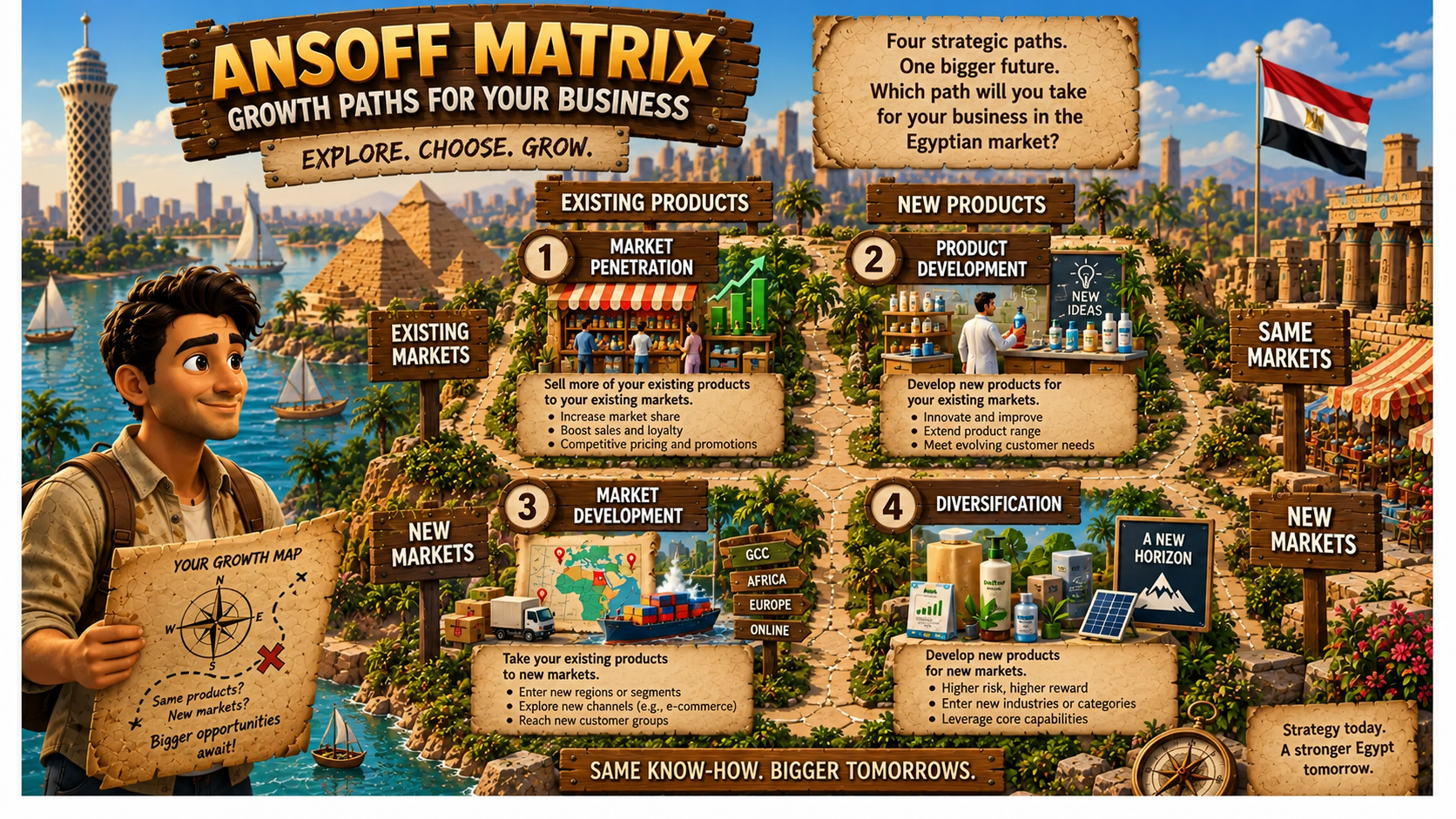
Ansoff Matrix
Pick a growth path: sell more of the same, develop new products, open new markets, or diversify.
Penetration lowest risk Product dev. medium risk Market dev. medium risk Diversify highest risk New ← markets → Existing Existing ← products → New Typical effort: 1–2 hours
Reach for it when You are planning growth for the next one to three years You are evaluating expansion options You are discussing risk appetite with partners Leave it in the bag when The core business is broken. Fix it before you grow it.
Explore the four growth paths in an Egyptian market setting.
?
What if your body-care brand must grow 50% next year?
A body-care brand with a loyal Cairo following is weighing its options.
How to apply Map your current products and markets List options in each quadrant Estimate the revenue potential and risk of each Sequence them, lower risk first Set milestones before moving to riskier boxes
Traps on the trail Jumping straight to diversification Underestimating how different a new market is Also reach for it when… What if you are considering expansion into Saudi Arabia? What if your board wants fast growth? Travels well with
Strategy Summit , landmark 5 of 5
BCG Growth-Share Matrix
Balance a portfolio of products by market growth and market share: stars, cash cows, question marks and dogs.
★ Star ? Question mark $ Cash cow ↓ Dog Low ← market growth → High High ← relative share → Low Typical effort: 1 hour with sales data
Reach for it when You have several products or business units You are allocating budget across product lines You need to decide what to cut Leave it in the bag when You are a single-product startup.
?
What if you have 14 products and budget to push only four?
A body-care brand's range has grown to 14 SKUs and the marketing budget is spread thin.
How to apply List units with their market growth and relative share Plot them on the matrix, sized by revenue Assign each a role: invest, hold, harvest or exit Move cash from cows to stars and chosen question marks Review every six to twelve months
Traps on the trail Killing dogs that help sell other products Using share numbers that nobody can verify Also reach for it when… What if one product funds all the others? What if you are preparing next year's marketing budget? Travels well with
Zone 5 of 8
Market Harbour
How do we take the offer to market and grow?
Market Harbour , landmark 1 of 4
Segment · Target · Position
Split the market into segments, choose the ones to target, then position clearly in their minds.
Segment Target Position Typical effort: Half a day
Reach for it when You are launching a product or brand Your marketing speaks to ‘everyone' You are entering a new market Leave it in the bag when You need one-to-one personalisation. Use personas and your CRM.
?
What if your plan targets ‘all women aged 18 to 45'?
The first Underarm Detox Scrub marketing plan aims at everyone, and the small budget is disappearing.
How to apply Segment by needs and behaviour, not only demographics Score segments on size, growth, fit and reach Choose one or two targets Write: For [target] who [need], [brand] is the [category] that [benefit] because [proof] Align the whole marketing mix to it
Traps on the trail Choosing a segment you can't reach Positioning on something competitors also claim Also reach for it when… What if your advertising budget is small? What if you are taking an Egyptian brand into the Saudi market? Travels well with
Market Harbour , landmark 2 of 4
Marketing Mix · 7Ps
Design the whole offer: product, price, place, promotion, people, process and physical evidence.
Target Product Price Place Promotion People Process Physical evidence Typical effort: Half a day
Reach for it when You are turning a strategy into a launch plan You are diagnosing why an offer isn't selling You sell a service where people and process matter Leave it in the bag when You haven't done STP yet. The mix needs a target.
?
What if your clinic is excellent but bookings are low?
A new physiotherapy clinic in Sheikh Zayed has great therapists and an empty diary.
How to apply Start from your target and positioning Decide each P so it supports the positioning Check the Ps are consistent with each other Budget and schedule Measure each P's contribution
Traps on the trail Premium price with a discount-store experience Treating promotion as the whole of marketing Also reach for it when… What if you are launching a new service line? What if customers say you are ‘too expensive'? Travels well with
Market Harbour , landmark 3 of 4
Price Sensitivity Meter
Find the acceptable price range from customers' own perceptions, using four simple questions (Van Westendorp).
Acceptable range Price (EGP) → Too cheap Too expensive Typical effort: A survey of 100+ people
Reach for it when You are pricing a new product You are testing a price increase You are setting a price for a new market Leave it in the bag when The market is a commodity with a fixed going rate.
?
What if you can't decide between EGP 250 and EGP 450 for your scrub?
200 women in the target segment answer four price questions about the Underarm Detox Scrub. Figures are illustrative.
How to apply Ask: too cheap, cheap, expensive, too expensive? Plot the four cumulative curves Read the range from where they cross Check margins and competitor prices Test in-market with a small launch
Traps on the trail Surveying people who would never buy Ignoring what the channel's margin does to the shelf price Also reach for it when… What if costs rise and you must raise prices? What if you are pricing a training course? Travels well with
Market Harbour , landmark 4 of 4
AARRR Growth Funnel
Diagnose growth through five stages: acquisition, activation, retention, referral and revenue.
Acquisition Activation Retention Referral Revenue leak Typical effort: An afternoon with analytics
Reach for it when You run a digital or subscription business Growth has stalled and you need to find the leak You are setting growth KPIs Leave it in the bag when Your B2B sales cycle is long and complex. Use a pipeline stage view.
?
What if you get 10,000 app downloads but very little revenue?
A food-delivery app for home cooks in Alexandria celebrates its downloads, then looks at the bank balance.
How to apply Define each stage for your business Measure conversion between stages Find the biggest leak Run experiments on that stage only Measure again every week
Traps on the trail Pouring more money into acquisition Vanity metrics such as downloads Also reach for it when… What if ad spend goes up but revenue doesn't? What if investors ask about your unit economics? Travels well with
Zone 6 of 8
Engine Rooms
Are we executing well, and what is breaking?
Engine Rooms , landmark 1 of 6
OKRs
Set a few ambitious objectives, each with measurable key results, so every team pulls in the same direction.
Objective KR 1 70% KR 2 40% KR 3 90% Key results Typical effort: Quarterly, 2–3 hours
Reach for it when Teams need to align on a few priorities You are turning strategy into quarterly focus A growing team is losing direction Leave it in the bag when You are tracking routine operations. Keep those as KPIs.
?
What if everyone is busy but the business isn't moving?
A 12-person marketing agency in Cairo works long hours on everything and grows on nothing.
How to apply Set one to three objectives per quarter Give each two to four measurable key results Link team OKRs to company OKRs Hold weekly check-ins Score and reflect at the end of the quarter
Traps on the trail Key results that are really task lists Linking OKRs directly to bonuses Also reach for it when… What if you have too many priorities? What if a new manager needs a clear mandate? Travels well with
Engine Rooms , landmark 2 of 6
Balanced Scorecard
Measure performance from four perspectives: financial, customer, internal process, and learning and growth.
Vision & strategy Financial Learning & growth Customer Internal process Typical effort: A 1-day design workshop
Reach for it when You are building a KPI system for a company or department You need to link strategy to measurement You want performance management beyond profit Leave it in the bag when The team is very small. It can become bureaucracy.
?
What if profit is up, but you feel the business is getting weaker?
An eight-branch pharmacy chain reports record revenue. The owner is uneasy.
How to apply Start from the strategy and its objectives Set objectives in each of the four perspectives Draw the cause-and-effect links between them Choose two or three KPIs with targets for each Review monthly
Traps on the trail Fifty KPIs that nobody reads Four lists with no cause-and-effect links Also reach for it when… What if you are designing a management dashboard? What if the owner only ever looks at sales? Travels well with
Engine Rooms , landmark 3 of 6
RACI Matrix
Make clear who is Responsible, who is Accountable, who is Consulted and who is Informed for each task.
Task Ops Brand Sales Finance Register A C I R Design C A I Listing I C R A Pricing R C C A Typical effort: 45 minutes
Reach for it when Projects with many people keep missing handovers You are introducing a new structure A process crosses several departments Leave it in the bag when The team is tiny and roles are already obvious.
?
What if the launch keeps slipping because ‘I thought you were doing it'?
A product launch team of eight has missed three deadlines in a row.
How to apply List the tasks or decisions List the roles Assign R, A, C and I for each task Check: one A per row, and not too many Cs Share it and review it at the kickoff
Traps on the trail Two people marked Accountable Consulting everyone and slowing everything Also reach for it when… What if two managers give conflicting instructions? What if you are restructuring the team? Travels well with
Engine Rooms , landmark 4 of 6
PDCA Cycle
Improve continuously in small, tested cycles: plan, do, check, act, and repeat.
Plan Do Check Act better each loop Typical effort: Cycles of 1–4 weeks
Reach for it when You want to improve a process step by step You have a quality problem You want to test a change before scaling it Leave it in the bag when You are in a crisis that needs an immediate decision. Act first, improve later.
?
What if delivery times keep getting longer?
An online store's average delivery time has crept from two to four days.
How to apply Plan: define the problem, the target and a hypothesis Do: test on a small scale Check: compare results with the target Act: standardise it, or adjust Start the next cycle
Traps on the trail Skipping Check and calling it done Testing too many changes at once Also reach for it when… What if you want to halve customer complaints? What if nobody follows the new procedure? Travels well with
Engine Rooms , landmark 5 of 6
Fishbone and 5 Whys
Find the root cause of a problem instead of treating its symptoms.
Problem People Methods Machines Materials Measure Place Typical effort: 1 hour with the people who do the work
Reach for it when A problem keeps coming back You face quality failures or complaints Meetings are full of blame Leave it in the bag when The problem has one obvious cause.
?
What if product returns suddenly double?
A cosmetics brand sees returns double in a single month, mostly for leaking jars.
How to apply Write the problem as the fish's head Draw bones: people, methods, machines, materials, measurement, environment Brainstorm causes along each bone Ask ‘why?' five times on the likeliest causes Verify with data, then fix the root
Traps on the trail Stopping at the first ‘why' Blaming people when the process is at fault Also reach for it when… What if a key KPI suddenly drops? What if the same mistake keeps happening? Travels well with
Engine Rooms , landmark 6 of 6
Pareto 80/20
Focus on the few causes that create most of the results.
80% The vital few The useful many Typical effort: 30 minutes with data
Reach for it when There are too many problems and too few resources You are prioritising customers, products or complaints You are cleaning up a product range Leave it in the bag when Every item is critical, such as safety issues.
?
What if you are drowning in 300 types of complaint?
A mobile-phone retailer's customer-service log is long, varied and overwhelming.
How to apply Collect data by category Sort from largest to smallest Calculate the cumulative percentage Find the vital few, around the 80% line Act on those first
Traps on the trail Ignoring small but dangerous issues Using counts when cost matters more Also reach for it when… What if you carry 200 SKUs and some barely sell? What if your sales team has too many accounts? Travels well with
Zone 7 of 8
Compass Point
How do we lead change and decide under uncertainty?
Compass Point , landmark 1 of 4
McKinsey 7S
Check that strategy, structure, systems, shared values, style, staff and skills all point the same way.
Strategy Structure Systems Style Staff Skills Shared values Typical effort: Half a day
Reach for it when You face a merger, restructuring or rapid growth A strategy exists but isn't being executed You are diagnosing organisational problems Leave it in the bag when The issue is small and tactical.
?
What if the new strategy is great but nothing changes?
A family-owned pharma distributor has decided to go digital. Six months later, nothing has moved.
How to apply Describe the current state of each S Describe the desired state Find the gaps and misalignments Start with the hard Ss that block the soft ones Plan and sequence the changes
Traps on the trail Changing structure and ignoring values Describing only the ideal state Also reach for it when… What if two companies are merging? What if you are growing from 20 to 100 employees? Travels well with
Compass Point , landmark 2 of 4
Kotter's 8 Steps
Lead organisational change in eight steps, from creating urgency to anchoring the new way in the culture.
1 Urgency 2 Coalition 3 Vision 4 Communicate 5 Barriers 6 Quick wins 7 Build on 8 Anchor Typical effort: Months, step by step
Reach for it when A major change is coming: a new system, structure or culture Past change efforts have failed People are resisting Leave it in the bag when The change is a small operational tweak.
?
What if your sales team refuses to use the new CRM?
Forty sales reps keep their customers in notebooks and WhatsApp. The new CRM sits empty.
How to apply Create urgency Build a guiding coalition Form a clear vision Communicate it again and again Remove barriers Create short-term wins Build on the gains Anchor it in the culture
Traps on the trail Declaring victory too early Communicating once by email Also reach for it when… What if you are launching a new performance system? What if a restructuring announcement is next month? Travels well with
Compass Point , landmark 3 of 4
Scenario Planning
Prepare for several plausible futures instead of betting everything on one forecast.
Export Shield Golden Gate The Storm Home Market High export demand Low Stable FX Volatile Typical effort: 1–2 day workshop
Reach for it when Uncertainty is high: currency, regulation, conflict, technology You face a long-term investment decision You want to stress-test a strategy Leave it in the bag when The decision is short-term and the environment is stable.
?
What if you are planning a factory investment and can't predict the currency?
A manufacturer is considering a new production line in 10th of Ramadan City.
How to apply Define the decision and the time horizon List the drivers; pick the two most uncertain and impactful Build a 2×2 of four futures; name and describe each Test your strategies against all four Agree early-warning signals
Traps on the trail Choosing the ‘most likely' future and ignoring the rest Drivers that are not truly uncertain Also reach for it when… What if there is major geopolitical uncertainty in the region? What if you are writing a five-year plan? Travels well with
Compass Point , landmark 4 of 4
Weighted Decision Matrix
Compare options against criteria weighted by importance, so the decision is transparent and defensible.
Option Footfall 30% Rent 25% Rivals 20% Total Zamalek 8 4 7 7.1 Sh. Zayed 8 8 9 8.2 Mokattam 6 8 5 6.4 Typical effort: 1 hour
Reach for it when You must choose between vendors, locations, hires or projects The team is split You need to document why a decision was made Leave it in the bag when One overriding criterion, such as a legal requirement, already decides it.
?
What if you must choose between three locations for a new branch?
A pharmacy chain has three shortlisted sites and a split management team.
How to apply List the options Agree criteria and weights before anyone scores Score each option from 1 to 10 Multiply and add up Test sensitivity by changing the weights
Traps on the trail Adjusting weights to get the answer you wanted Too many criteria Also reach for it when… What if you are choosing a distributor? What if you are torn between two strong candidates? Travels well with
Zone 8 of 8
Sales Caravan
How do we run sales and grow revenue, month after month?
Sales Caravan , landmark 1 of 4
Sales Pipeline Stages
Move every deal through clear stages — lead, qualified, meeting, proposal, negotiation, won — so nothing hides and nothing stalls.
Lead Qualified Meeting Proposal Won Typical effort: One afternoon
Reach for it when Deals stall for months with no clear reason Your forecast is a guess written on a Friday New reps invent their own process Leave it in the bag when You sell one or two huge deals a year. Manage those as projects instead.
?
What if your 'hot deals' never seem to close?
A Cairo office-furniture distributor counts 40 deals 'in progress', yet the month ends flat again.
How to apply Define your stages and the exit rule for each Place every open deal on exactly one stage Give each deal a next step with a date Review weekly: what moved, what stalled, what left Clean ruthlessly — a dead deal kept warm still dies
Traps on the trail Counting deals with no next step as 'active' Stages so loose that everything sits in 'negotiation' Also reach for it when… What if your sales manager asks 'where is the number?' What if a new rep joins and asks how we sell here? Travels well with
Sales Caravan , landmark 2 of 4
SPIN Selling
Ask Situation, Problem, Implication and Need-payoff questions in order, so the buyer — not you — says why the purchase matters.
S P I N Situation Problem Implication Need-payoff Ask in this order — let the buyer say the value Typical effort: One ride-along day
Reach for it when Buyers enjoy the meeting, then go quiet Your pitch is a list of features and prices You sell something expensive with a long decision Leave it in the bag when The buyer already knows exactly what they want and asked for a quote. Just quote.
?
What if your pitch lists features but the buyer says 'we'll think about it'?
A medical-equipment rep in Alexandria shows pumps and monitors to a hospital procurement manager who keeps nodding — and never signs.
How to apply Write five questions per letter before the visit Start with situation facts you cannot read online Follow each problem with 'and what does that cause?' Stay quiet after need-payoff — let the number land Summarise their words, then present only what matches
Traps on the trail Machine-gunning situation questions like an interrogation Jumping to the product before the pain is fully priced Also reach for it when… What if the buyer says your price is too high? What if a Saudi buyer keeps saying 'inshallah, soon'? Travels well with
Sales Caravan , landmark 3 of 4
BANT Qualification
Qualify every opportunity on Budget, Authority, Need and Timeline — and walk away early from the ones that fail.
Budget — is money allocated? Authority — who signs? Need — is the pain real? Timeline — when do they decide? Typical effort: One hour
Reach for it when The team is busy but revenue stays flat Deals die at the signature stage, again and again A 'big opportunity' has eaten six weeks of effort Leave it in the bag when Everyone in the deal is known and proven. Then keep a light checklist, not a gate.
?
What if your team spends six weeks on a lead who was never going to buy?
A Riyadh software lead loves the demos and books meeting after meeting. The team celebrates — until procurement asks who approved the budget. Nobody did.
How to apply Ask the budget question early — politely but directly Name the signer in your notes, or treat the deal as unqualified Score need by the cost of doing nothing, not by enthusiasm Write the decision date; a deal without one is a hobby Review BANT at every pipeline meeting
Traps on the trail Believing a friendly contact is the decision maker Counting 'they liked the demo' as a qualified need Also reach for it when… What if procurement joins the meeting for the first time? What if the deal is big but the timeline keeps slipping? Travels well with
Sales Caravan , landmark 4 of 4
Sales KPIs & Forecast
Track win rate, average deal size, cycle length and pipeline coverage — then forecast with stage weights, not feelings.
Win rate Deal size Cycle Coverage 3× Typical effort: One week to set up
Reach for it when You must commit a number to the CEO or investors Reps promise revenue that never lands The quarter ends in surprises — good or bad Leave it in the bag when You have fewer than five deals. A forecast on that is astrology; work the deals.
?
What if the target is 12 million and nobody knows if you will hit it?
A Cairo sales manager promises the year-end number by feeling. The CEO plans hiring around it. The pipeline says something else entirely.
How to apply Fix four numbers: win rate, deal size, cycle, coverage Compute coverage = pipeline ÷ target; aim near 3× Weight each stage by its historic close rate Report three lines: commit, best case, pipeline Review monthly and adjust the weights with real results
Traps on the trail Letting each rep invent their own forecast Forecasting from effort ('we worked hard') instead of stages Also reach for it when… What if the CEO asks 'why should I believe this number?' What if one superstar rep carries half the target? Travels well with
Expedition routes
Big journeys need more than one lens. These routes chain frameworks in the order they usually work best. Tap any stone to open it.
Quick reference
All 39 frameworks on one page, with the moment each one is made for.